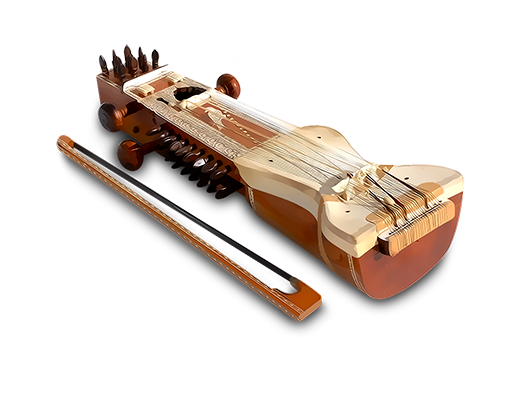
The Sarangi
Sarangi also known as Saurangi , which means an instrument with hundreds of colours. Sarangi is the most important bowed instrument in Hindutani Music. The unearthly beautiful sound of Sarangi is one of the most rare and greatest gifts Indian Classical Music has to offer to the rest of the world. It is said that the Sarangi's sound is closest to the human voice in richness and melody, affording intense emotional expression.
The present day Sarangi's body is carved out of a single piece of hard wood usually ‘TUN’ (Indian Cedar). The hollowed lower portion is covered covered with goat skin, the middle with wood to form a finger board and the top is a box which contains fixed pegs. It is played with the belly portion resting either on the ground or on the player’s lap. The Sarangi has three main gut strings and 35-40 sympathetic strings that provide a sonorous resonance.
Unlike any other musical instrument, the main gut strings of Sarangi are slided by the bow and that provides the basic sound.
To produce a specific note or to play a melody, these strings are stopped sideways by the cuticles of the fingers.
It can be performed as a solo instrument as well as an accompaniment to vocal performance.
A basic to advance Sarangi Instrument would cost from $350 to $2500.
History of Sarangi
Sarangi has its predecessors in early folk instruments and also some instruments of Persian Origin.
The name Sarangi Occurs in prominent musicological works from the 13th century. A still earlier Veena (a plucked string instrument) called the Pinakini Veena bears a striking close resemblance with Sarangi. This could be logically accepted as a forerunner of The Sarangi.
Benefits of Learning Sarangi
Sarangi players get to develop vocal music skills because Sarangi-playing requires that the player first learns to sing before they begin to play the instrument.
Sarangi players get to play various styles of music, both Indian & western genres. This enables them to acquire a vast knowledge of music.
Sarangi players frequently perform alongside tabla and dance performers. This helps them achieve a strong understanding of rhythmic tempo.